
However, the tender criteria demands that an entity must be eligible to conduct Beyond Visual Line of Sight operations in order to become eligible. Currently, no drone companies are eligible to do BVLOS operations, reports Arindam Majumder.

These clauses deal with penalties, licences, registration and National Transport Policy, among others.

The minister, however, said she was not in favour of relaxing rules for Apple to sell refurbished second-hand phones in India

As per commerce and industry ministry data, food inflation fell to 4.91 per cent in March from 7.79 per cent in the previous month.
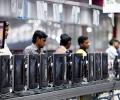
It was expected that supplies from China will be back to normal by end-June as their factories are now operating at nearly 90 per cent of normal capacity. But the recent issue with shipments has placed an obstacle that manufacturers can't bypass.

Koo, which works on similar lines as Twitter, was born with a focus on regional language, unlike Twitter and Facebook, which are very popular but primarily cater to an English-speaking audience, reports Neha Alawadhi.

The Pakistan government on Monday appeared divided over resuming onion exports to India with the Agriculture Ministry not averse to lifting the ban but the Commerce Ministry has some reservations.

The output of eight core infrastructure sectors contracted for the third month in a row by 1.3 per cent in December 2020, dragged down by poor show by crude oil, natural gas, refinery products, fertiliser, steel and cement sectors. The core sectors had expanded by 3.1 per cent in December 2019, according to the provisional data released by the Commerce and Industry Ministry on Friday. Barring coal and electricity, all sectors recorded negative growth in December 2020. During April-December 2020-21, the sectors' output declined by 10.1 per cent against a growth rate of 0.6 per cent in the same period of the previous year.

The wholesale price-based inflation rose to an eight-month high of 1.48 per cent in October, as manufactured products turned costlier. The WPI inflation was 1.32 per cent in September and zero per cent in October last year. This is the highest level of wholesale price index-based (WPI) inflation since February when it was 2.26 per cent.

The country's exports rose by 48.34 per cent to $32.5 billion on account of healthy growth in shipments of petroleum products, gems and jewellery, and chemicals, leather and marine goods, according to the data released by the Commerce Ministry on Thursday. Imports in June too rose by 98.31 per cent to $41.87 billion, leaving a trade deficit of $9.37 billion as against a trade surplus of $0.79 billion in the same month last year. During April-June 2021, the exports increased by 85.88 per cent to $95.39 billion.

An undeterred Chief Executive Officer of NSO Group, Shalev Hulio, in an interview to Israeli Channel 12 on Saturday, strongly defended the company's operations, though he also conceded that some 'mistakes' may have happened over the years.

The government has budgeted for total expenditure of Rs 34.83 lakh crore or 6.8 per cent of GDP. While the net tax revenue rose from Rs 5,75,697 crore in October 2020 to Rs 10,53,135 crore till October 2021, a growth of 82.93 per cent annualized, total expenditure rose only by 9.95 per cent, led by infra spending to Rs 18,26,725 crore from Rs 16,61,454 crore during the same period, the RBI said in the financial stability report.

Retail inflation hit an eight-month high of 6.07 per cent in February, remaining above the RBI's comfort level for the second month in a row, while wholesale price-based inflation soared to 13.11 per cent on account of hardening of crude oil and non-food item prices, government data showed on Monday. The previous high for retail inflation was 6.26 per cent in June 2021. The consumer price index (CPI) based retail inflation, which is taken into account by the Reserve Bank of India (RBI) while deciding its monetary policy, rose mainly because of costlier food items, as per the data released by the National Statistical Office (NSO).

'We look forward to seeing them show off their knowledge and hard work as they square off against the dictionary on the national stage.'

The Centre on Wednesday announced a raft of post-retirement employment possibilities for 'Agniveer' like priority in recruitment to the central armed police forces (CAPF) and Assam rifles but that failed to assuage the concerns of the opposition Congress which warned the 'transformative' 'Agnipath' scheme will reduce the operational effectiveness of the armed forces.

PM has been regularly seeking people's inputs through mygov.in and his app, to assess the mood of the nation.

'For the first time, all major countries are discovering India's indispensability to their own foreign policy interests.'

Contracting for the ninth consecutive month, the output of eight core infrastructure sectors dropped by 2.6 per cent in November, mainly due to decline in production of natural gas, refinery products, steel and cement. The production of eight core sectors had recorded a growth of 0.7 per cent in November 2019, data released by the commerce and industry ministry showed on Thursday. Barring coal, fertiliser and electricity, all sectors -- crude oil, natural gas, refinery products, steel and cement -- recorded negative growth in November 2020.

16 national and regional industry bodies and sectoral business lobbies video-conferenced with Commerce and Industry Minister Piyush Goyal on Saturday and raised key concerns facing Indian industry in the wake of the 21-day lockdown over coronavirus.

The Modi government has to embrace the history of Tamil conquests in South East Asia and stop obsessing about Babar/Humayun, argues Colonel Anil A Athale (retd).

Sitharaman, who became the first full-time woman defence minister in the first tenure of the Bharatiya Janata Party-led National Democratic Alliance government -- will also head the Corporate Affairs ministry in the new cabinet.

Far more important than governance is to ensure how different states get necessary representation a'The pressure to expand the council of ministers will come from states where the BJP has formed a government after ousting the Congress,' predicts A K Bhattacharya.

Finance Minister Nirmala Sitharaman on Monday said the government is planning to extend the suspension of fresh insolvency proceedings for another three months, a move which will provide major relief to corporate borrowers hit by the coronavirus pandemic. Addressing the Bangalore Chamber Of Industry And Commerce (BCIC), she said the government has taken several measures, including deferment of tax payment date, to help businesses and people.


Sectors which attracted maximum foreign inflows during April-June 2019-20 include services (USD 2.8 billion), computer software and hardware (USD 2.24 billion), telecommunications (USD 4.22 billion), and trading (USD 1.13 billion), the commerce and industry ministry data showed.

Barring coal and fertiliser, all sectors -- crude oil, natural gas, refinery products, steel, cement and electricity -- recorded negative growth in August.

Trade deficit marginally widened to $9.85 billion as against $9.72 billion in February 2019.

The retail inflation rate breached the 6 per cent upper tolerance limit of the RBI for the first time in seven months in January, while the wholesale price index stayed in double-digits for the 10th month in a row, showed two sets of data released by the government on Monday. Retail inflation, the key input for the RBI while reviewing the repo rate every two months, soared during the month mainly because of a spike in certain food items. The previous high for retail inflation was 6.26 per cent in June 2021.

The move to resume work in ministries comes nearly a month after the government issued work from home protocols in its fight against the coronavirus pandemic.

Commerce and Industry Minister Piyush Goyal on Monday said the existing foreign trade policy (FTP) will be extended for six months till March 31 next year. The government had earlier extended the FTP 2015-20 until September 30 this year due to the Covid-19 crisis. The FTP provides guidelines for enhancing exports to push economic growth and create jobs.

With the abolition of the Foreign Investment Promotion Board (FIPB), Amazon's proposal will now be vetted by the Department of Industrial Policy and Promotion (DIPP) under the commerce ministry.

'The people of Jammu and Kashmir are your own people. Do not use them as cannon fodder in your laboratory.'

In what may help beleaguered airlines Kingfisher, the finance ministry has approved a draft Cabinet note floated by the commerce and industry ministry allowing foreign fliers to acquire up to 26 per cent stake in India's aviation companies.

The Union home ministry on May 13 had declared that these canteens will only sell indigenous or "swadeshi" products from June 1 in a bid to give fillip to domestic industries.

The appointment of new expenditure secretary comes a month-and-a-half ahead of the Budget for 2020-21 to be presented on February 1.

While Reliance has the clout to negotiate prices with suppliers for its e-commerce, not to forget the cost advantage of integrated warehouse and supply chains, Amazon and Walmart are no pushovers, they too have deep pockets.

The Supreme Court has taken cognisance of the Lakhimpur Kheri incident in which eight people were killed in violence during a farmers' protest, with a bench headed by Chief Justice of India N V Ramana scheduled to hear the matter on Thursday.

MAG was constituted by Department of Electronics and IT in February 2014.

Rahul Khullar's guiding credo was that a civil servant must never lose sight of his client: The little guy. The evil men are those who are decision-makers but abdicate their responsibility of taking decisions, leading people to lose confidence in public institutions.

The GST Council on Saturday is expected to extend the date for IGST exemption and cess on imports
